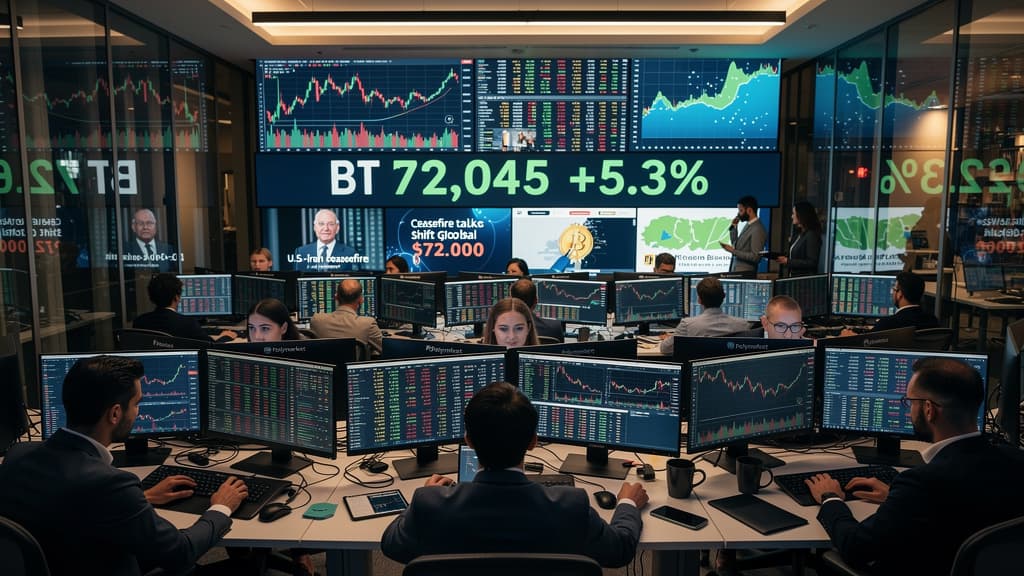
Polymarket Traders' Strategic Move
Three traders on the prediction market platform Polymarket made statistically successful bets by wagering on a ceasefire between the United States and Iran. The bets were placed with probabilities ranging from 2.9% to 10.3%, as identified by Lookonchain, a blockchain analytics provider. These bets were recorded within 26 hours preceding the announcement of the ceasefire agreement, marking them as significantly advantageous [1][3].
Market Reaction to Ceasefire
Following the ceasefire announcement, multiple financial markets experienced notable movements. The global price of Bitcoin, a leading cryptocurrency, surged past $72,000 in late trading sessions on Tuesday, significantly impacting short sellers. In a 24-hour period, approximately $427 million was lost by those betting against a de-escalation in the ongoing geopolitical tensions between the United States and Iran [1][2].
Broader Crypto Market Movements
The crypto market exhibited various changes alongside Bitcoin's rise. Ethereum, the second-largest cryptocurrency by market capitalization, saw a price increase of 7.08%, reaching $2,249.69. Other digital assets, including XRP and BNB, also experienced gains. Overall, the crypto market's reaction appears tied to an increased appetite for risk assets following the geopolitical news [1].
Background of the US-Iran Tensions
The United States and Iran have been involved in ongoing tensions, affecting multiple aspects of international relations and economic stability. The ceasefire agreement, currently set for a two-week duration, marks a temporary pause in hostilities. This development follows a series of diplomatic engagements aimed at reducing the risk of broader conflict.
Future Implications
The traders' actions on Polymarket and the subsequent movements in financial markets highlight the intersection of geopolitics and cryptocurrency trading. It remains to be seen how sustained these trends will be, as they depend heavily on the stability of the current diplomatic situation between the involved nations [2][3].